

Cybersecurity
Governance Program
Built around your business. Grounded in recognized standards. Delivered as a partner.
A Program. Not a Project.
Most security consultants conduct an assessment, hand over a report, and move on. You’re left holding a document and wondering what to do with it.
Data Security Partners takes a different approach. This is what a fractional CISO relationship looks like in practice — not a report, a role. We build your security program — and stay to manage it, measure it, and improve it over three years. Every quarter you have a clear agenda, a written report, and an active partner handling the security pressures your business faces every day.
COMPARISON TABLE
| TYPICAL SECURITY CONSULTANT | DATA SECURITY PARTNERS | |
| Engagement Model | Project-based — in and out | 3-year governance program |
| Deliverable | A report | A living program |
| After Delivery | Gone | Ongoing partner |
| Vendor Questionnaires | Not included | Handled for you |
| Accountability | None after delivery | Quarterly Business Reviews |
| Goal | Check a box | Demonstrate Due Care |
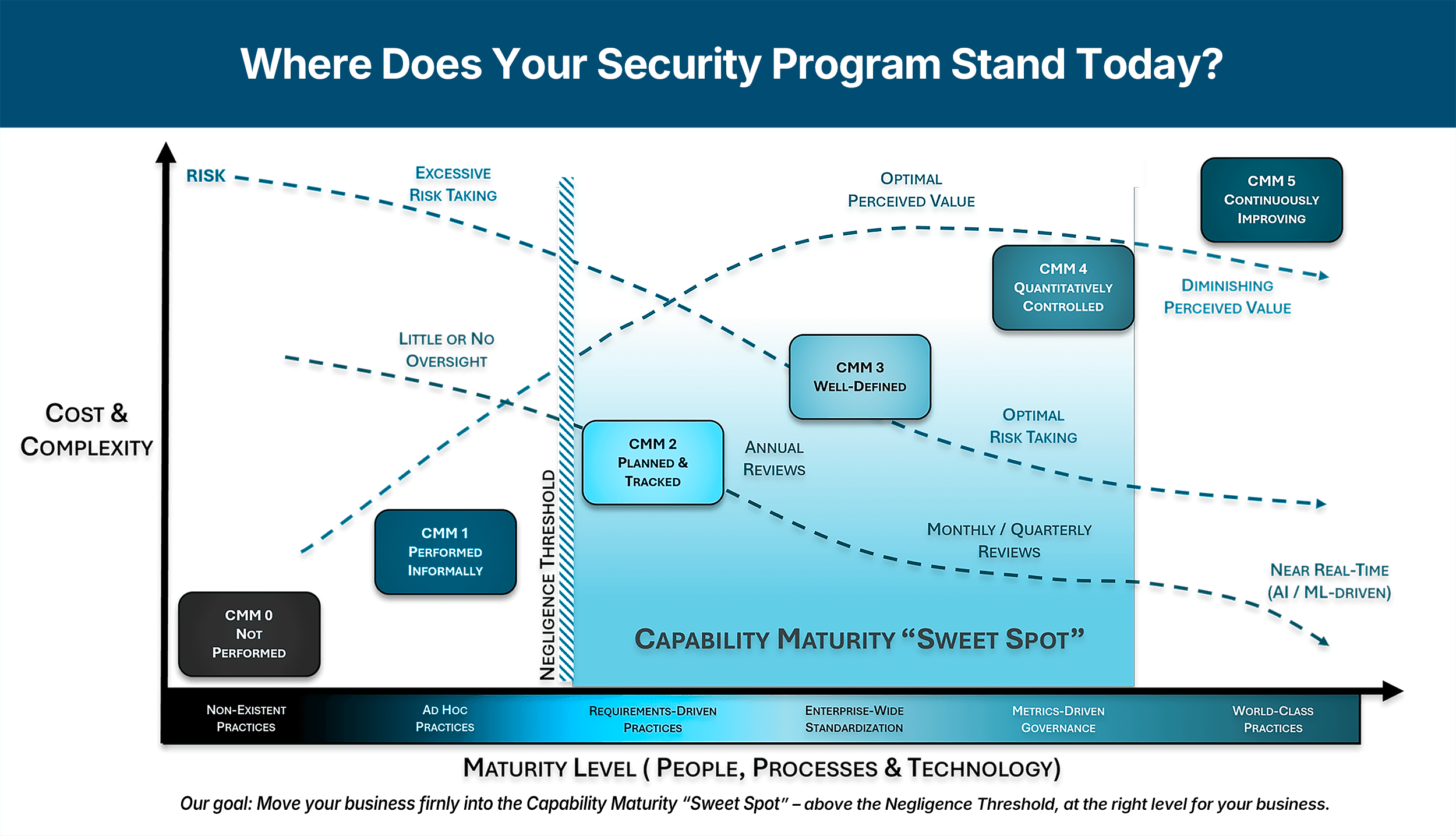
Source: ComplianceForge
At the heart of every Cybersecurity Governance Program engagement is the Risk Management Program (RMP) — the living document that governs your internal security posture. It draws from leading Best Practices for risk management: NIST, COSO, COBIT, and ISO. The RMP articulates how your organization identifies sensitive data and how it will assess, analyze, and mitigate risk. It is the primary documentation demonstrating due care to regulators, insurers, and clients. You cannot effectively manage risks you don’t know about — and without a documented RMP, you cannot demonstrate that you’ve tried.
The Cybersecurity Governance Program is built on NIST 800-53 — our default framework. It’s comprehensive, it maps cleanly to CIS Controls, PCI-DSS, HIPAA, and NIST 800-171, and it gives your program room to grow no matter which compliance drivers matter most to you today.
“Build-in, don’t bolt-on. Starting with a comprehensive framework and calibrating its activation to your current size costs nothing extra and preserves full optionality. Retrofitting a lighter framework later costs more, takes longer, and happens under someone else’s deadline.“
Security as a Business Strategy
Most organizations treat cybersecurity as overhead — a cost center, a compliance checkbox, a necessary evil. Done right, it’s something else entirely.
A mature security program can be a market differentiator that eliminates sales roadblocks. It creates operational efficiencies by building security into how your business runs rather than bolting it on afterward. It shifts the conversation from “what does this cost us?” to “what does this enable?”
That’s what a culture of security looks like in practice. Compliance is the floor, not the ceiling.

Identify
Asset inventory, threat landscape, CIS Controls assessment, CIS Benchmark evaluations of specific systems and devices.

Understand
Risk Analysis — evaluating likelihood, business impact, and context. Populates your Risk Register with prioritized, actionable findings.

Mitigate
Prioritized remediation, system hardening*, control implementation, vendor questionnaire support.

Monitor and Review
Quarterly benchmark assessments, QBR reporting, annual program reassessment, program updates.
* System hardening — IT systems ship configured for ease of deployment, not security. Adjusting configuration parameters costs nothing but significantly reduces your attack surface.
CHOOSE A TIER
Three Tiers. One Standard.
Every tier includes Quarterly Business Reviews, Annual Program Risk Assessments, CIS Benchmark asset assessments, and vendor questionnaire support. The difference is depth — and the signature deliverable each tier produces.

Foundational
Risk Management
Best for: Clients with solid existing policies who need a documented risk management program and annual assessment cadence
- Risk Management Program (RMP) (signature deliverable)
- Annual Program Risk Assessment
(x4 over 3 years) - CIS Benchmark Asset Assessments —
1 asset type/quarter - Vendor Security Questionnaire Support— 2/month
- Quarterly Business Reviews
$3,750/month
+ $3,750 Onboarding Fee

Essential
Cyberhygiene
Best for: Clients who need both the risk management foundation and a complete, framework-aligned policy library
- Everything in Tier 1
- Framework Aligned Policies(signature deliverable)
- CIS Benchmark Asset Assessments —2 asset types/quarter
- Vendor Security Questionnaire Support — 4/month
- Complete Policy Documentation Stack
$6,000/month
+ $6,000 Onboarding Fee

Complete Cybersecurity
Governance Program
Best for: Clients who want to create a culture of security with a robust risk management program, framework-aligned policies, and operational procedures tailored to their organization
- Everything in Tier 2
- Cybersecurity SOPs (CSOPs)
(signature deliverable) - CIS Benchmark Asset Assessments —
3 asset types/quarter - Vendor Security Questionnaire Support — 6/month
- Culture of Security
$8,000/month
+ $8,000 Onboarding Fee
Additional vendor questionnaire support beyond monthly cap available at $350/each (Tier 1), $300/each (Tier 2), $250/each (Tier 3).
PROGRAM DOCUMENTATION
A Structured Architecture – Not Just a Stack of Templates
Your security program documentation isn’t a single policy document. It’s a structured hierarchy — each layer linked to NIST 800-53, our default framework, and the recognized control standards it maps to — each building on the layer below.
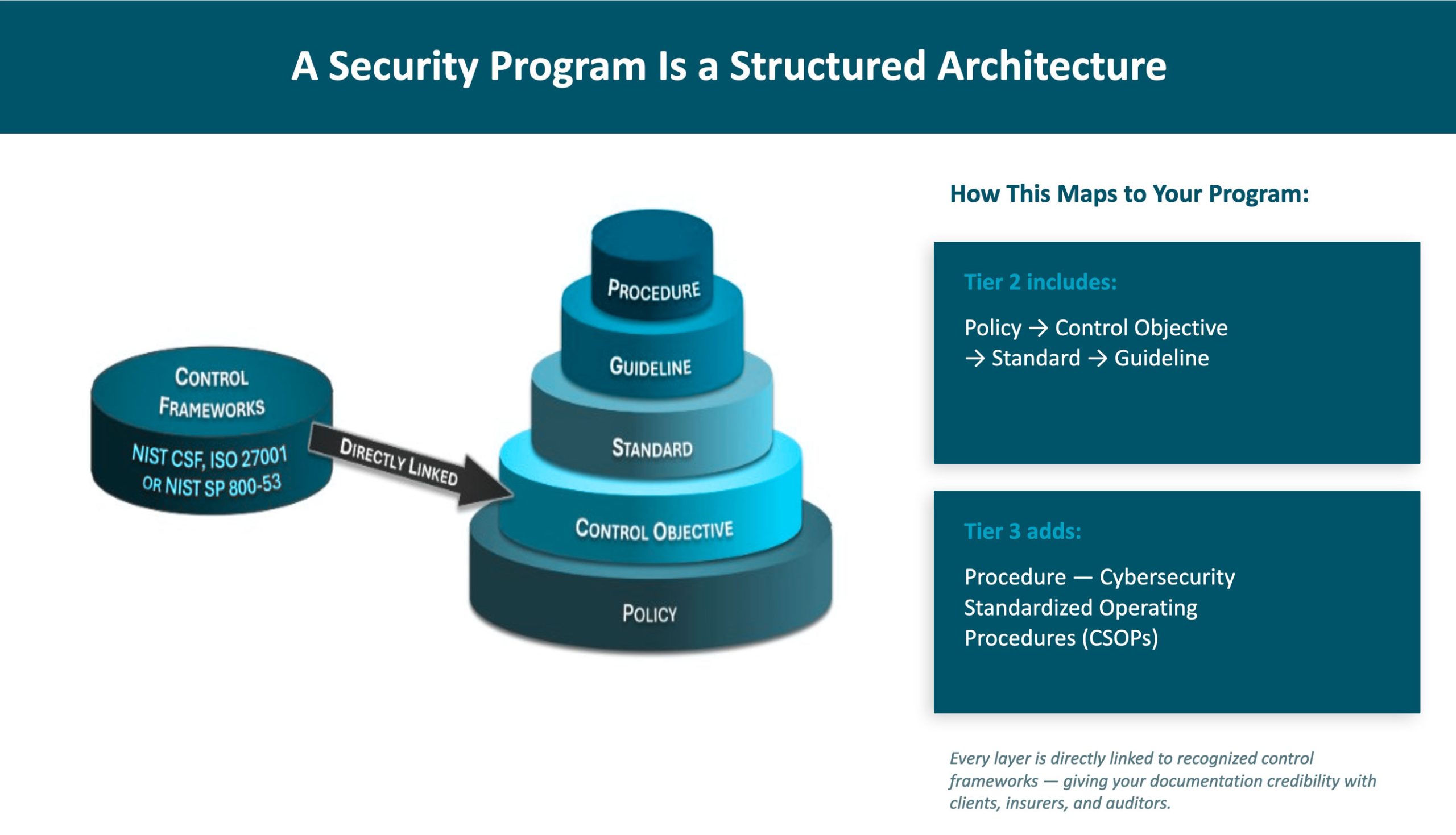
Source: ComplianceForge
TIER 1
Establishes:
Risk Management
Program (RMP)
The governing document that drives everything else. Articulates how your organization identifies sensitive data, assesses risk, and manages mitigation. The RMP is the foundation all other documentation builds on — and the primary evidence of due care.
TIER 2
Builds:
Policy → Control Objective → Standard → Guideline
The complete corporate-level documentation foundation — directly linked to recognized control frameworks. Written for your specific environment, not just adapted from generic templates.
TIER 3
Adds:
Cybersecurity Standardized Operating Procedures (CSOPs)
The operational layer — step-by-step instructions that bring security down to the department and team level. Owned by your department heads and team leaders. This is how a Culture of Security becomes embedded in how your organization actually operates, not just documented in a binder.
Engaging as a Group of Related Companies?
If multiple related companies are considering an engagement simultaneously, we offer a Group Engagement Rate that reflects the genuine efficiencies of building programs across a connected organization.
| Companies Engaging | Group Rate | TIER 1 Monthly | TIER 2 Monthly | TIER 3 Monthly | TIER 2 – 3 Year Savings |
| 2-3 Companies | 10% Off | $3,375/ mo. | $5,400/ mo. | $7,200/ mo. | $21,600 |
| 4-6 Companies | 15% Off | $3,188/ mo. | $5,100/ mo. | $6,800/ mo. | $32,400 |
| 7-9 Companies | 20% Off | $3,000/ mo. | $4,800/ mo. | $6,400/ mo. | $43,200 |
HOW WE START
Every Engagement Begins with a Foundation
The first 90 days of every engagement are the most important. Here’s what we build together — and why it matters.
Month 1
Onboarding & Discovery
Client environment review, stakeholder interviews, asset inventory, vendor questionnaire support begins.
Month 2
Assessment & Analysis
CIS Controls-based Annual Program Risk Assessment, Risk Analysis, findings documented, priority risks identified.
Month 3
Program Initialization
Risk Management Program (RMP) — foundational sections, Risk Register populated, vendor questionnaire support continues, QBR preparation.
We’re Confident in What We Deliver. You Should Be Too — Before You Commit.
At the end of your Foundation Phase — Day 90 — we sit down for your first Quarterly Business Review. We walk you through everything we’ve built, everything we’ve found, and exactly what the next 33 months look like.
At that point — you decide to continue, or not. No penalty. No pressure. You keep everything we built.
Most clients continue. Because by Day 90, they’ve seen exactly what a mature security program looks like for their business — and they understand what it takes to get there.
| TIER 1 | TIER 2 | TIER 3 | |
| Onboarding Fee | $3,750 | $6,000 | $8,000 |
| 3 Monthly Payments | $11,250 | $18,000 | $24,000 |
| Total at Decision Point | $15,000 | $24,000 | $32,000 |
| Full 3-Year Investment (If you continue) | $138,750 | $222,000 | $296,000 |
Full 3-year figures assume you continue past Day 90. You can exit at Day 90 with no penalty, and the engagement agreement includes an early-termination option.
WHAT TO EXPECT
Consistent Engagement. No Surprises. Always Know Where You Stand.
Not sure which tier is right for your business?
We’ll help you figure that out. The next step is a 30-minute conversation — no obligation, no pressure.
Not ready for a full program yet?
Our standalone Security Risk Assessment is a natural starting point. A CIS Controls-based evaluation of your current security posture — $7,500 flat fee, no ongoing commitment. But if you do continue on to a full Governance Program within 90 days, we’ll waive your onboarding fee entirely.